

Lauren Sánchez officially became Mrs. Bezos in June 2025. Nice wedding. Big yacht. But here’s the only question that matters if you’re reading a BaZi blog instead of a gossip column:
Where, exactly, does her chart say “wealth arrives through this marriage”? Not vaguely. Not “the spouse palace looks nice.” Point to the pillar. Name the god. If you can’t do that in one sentence, you’re not reading a chart — you’re reading tea leaves with extra steps.
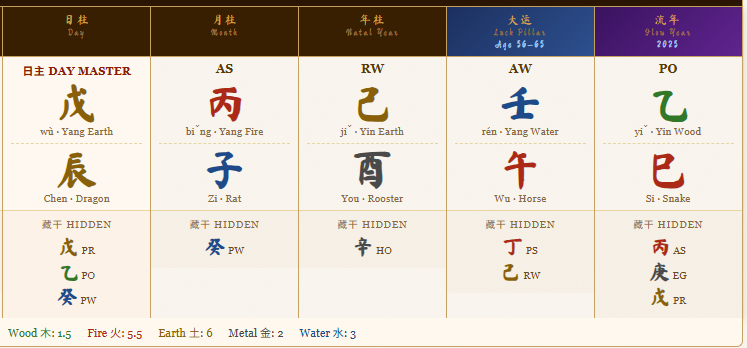
Here’s the collision nobody’s naming properly: her current Luck Pillar is Ren Wu (壬午). Her Month Pillar is Bing Zi (丙子). Stem clashes stem — Bing against Ren. Branch clashes branch — Zi against Wu. Both fronts, at once, mirrored.
For anyone new here — what is Fu Yin (伏吟), actually?
Strip away the mysticism: Fu Yin is what happens when one pillar collides with another on both levels at the same time — the Heavenly Stem clashes the Stem, and the Earthly Branch clashes the Branch, in the same pairing. Not a partial hit. A full, mirrored collision.
That’s rarer than a single clash, and it’s louder. An ordinary branch clash might rattle one area of your life — career, health, relationships — depending on which palace it lands in. This doubles down: stem and branch, hitting at once. It’s the difference between someone bumping your shoulder and someone T-boning your car.
(Some schools reserve the word “Fan Yin” for this exact double-clash and save “Fu Yin” for a pillar repeating itself verbatim. Argue about the label if that’s how you enjoy spending your time — I’d rather argue about whether you can actually read what it does, because that’s the part everyone keeps getting wrong.)
Now watch what every textbook does with that.
Pull up any standard reference and you’ll get the same recycled verdict: a double clash like this is trouble — instability, loss, someone gets hurt. That’s the textbook line, and it’s exactly why so many practitioners get real charts wrong.
Because in this chart, that same configuration lines up with the single biggest, most publicly celebrated event of her adult life. Not a disaster. A wedding to one of the richest men on earth.
So which is it — is the theory wrong, or is the person reading it wrong?
I’ll tell you which. The theory isn’t broken. The resolution most people run it at is. “Clash equals bad” is a beginner’s shortcut — it skips what’s actually clashing, what element it releases, what the Day Master needs, and where in the luck cycle you’re standing. Say “clash is bad” with enough confidence and you’ll sound like an expert to a room full of beginners. You’ll also be dead wrong the second a real chart doesn’t cooperate.
That’s the actual story here. Not the wedding — the fact that this shallow rule gets repeated across a hundred BaZi accounts, and not one of them stress-tests it against a chart with a verifiable, public outcome sitting right in front of them.
So here’s the question back at you: if a rule can’t survive contact with one documented wedding chart, why is it still in your toolkit?
A crowded market isn’t a correct one. Repeating the consensus takes no skill and zero accountability. Building a system precise enough to survive being checked, pillar by pillar, against real outcomes — that’s the hard part, and almost nobody does it.
Fame gets you an audience. It has never once gotten anyone a correct reading.
Decide now: do you want to sound like everyone else, or do you want to be right?


